

For many WA parents, ASET preparation can feel confusing because the test does not simply assess what a child has memorized at school. The Academic Selective Entrance Test, often known as the ASET or GATE test, is designed to identify students who can think carefully, solve problems, understand complex ideas and communicate clearly under pressure.
One of the most important parts of the ASET is Communicating Ideas in Writing.
This writing section is not a simple school story-writing task. It does not reward students who only memorize a prepared story, follow a basic formula or fill a page with difficult vocabulary. Strong ASET writing shows that a student can think creatively, respond directly to a prompt and shape ideas in a clear, original and controlled way.
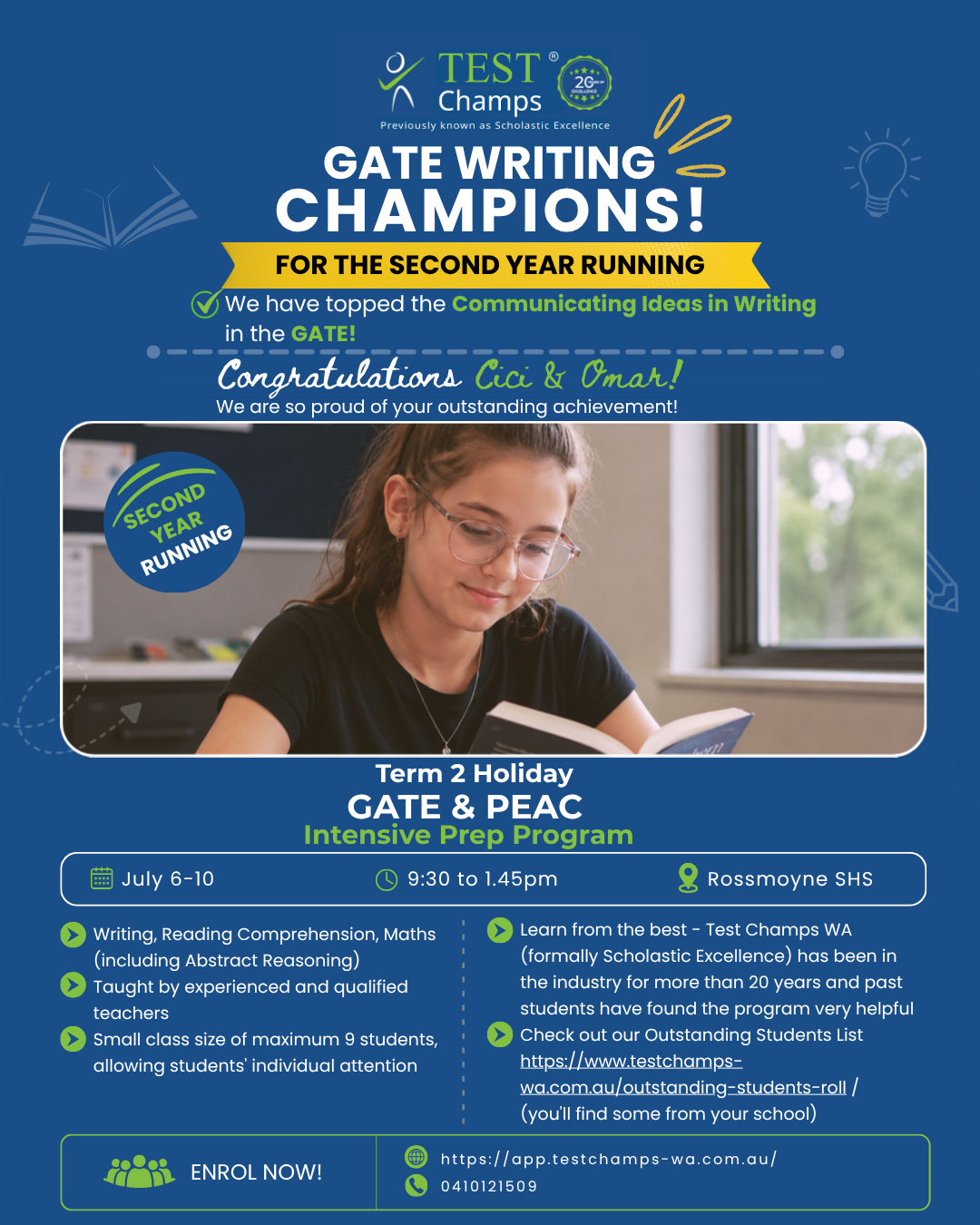
At Test Champs WA, we are proud to share that our students have once again achieved outstanding results in the WA Gifted and Talented selection process. Most excitingly, our student Omar achieved the top result in the state for writing. Last year, Cici also achieved the top writing result. We are incredibly proud of these students and the hard work behind their success.
Their results show something important: strong writing is not only about neat sentences. It is about strong thinking.
What Is the ASET Writing Section?
The ASET includes four parts:
- Reading Comprehension
- Communicating Ideas in Writing
- Quantitative Reasoning
- Abstract Reasoning
The writing section is called Communicating Ideas in Writing. In this part of the exam, students respond to a prompt. The prompt may be a picture, phrase, statement or idea.
Students are expected to create a written response that is clearly connected to the prompt. They need to think quickly, plan carefully and write with purpose.
This is where many bright students struggle. They may know how to write a story at school, but they may not know how to create an original idea quickly during a timed exam.
What Are ASET Writing Markers Looking For?
ASET writing markers are not only looking for correct spelling, grammar and punctuation. These skills matter, but they are not enough on their own.
A strong ASET writing response should show:
- a clear connection to the prompt
- fresh and original ideas
- strong organization
- a clear writing voice
- thoughtful word choice
- expressive language
- an interesting plot, message or idea
- controlled sentences and paragraphs
- a purposeful ending
This means a technically correct piece may still not stand out if the idea is too predictable.
For example, if the prompt shows an open door, many students may write about walking into a mysterious room. That idea can work, but it is also very common.
A more creative student might write from the point of view of the door itself. Another student might write about a child who refuses to open the door because it represents a difficult truth. Another might use the door as a symbol for courage, change or opportunity.
The difference is not just writing skill. It is thinking skill.
Why Creative Thinking Helps Students Stand Out
Creative thinking helps students move beyond the first obvious idea.
In ASET writing, students need to show that they can interpret a prompt in a thoughtful way. A simple prompt can become much stronger when the student sees deeper possibilities.
For example:
- A broken clock could be about time, regret, memory or a family moment that cannot return.
- A bird flying over a city could be about freedom, loneliness, courage or seeing life from a new angle.
- A child standing alone could be about belonging, resilience or the bravery of speaking up.
- A locked gate could be about fear, opportunity, secrets or change.
Creative writing does not mean writing something random or confusing. It means making original choices that still make sense.
The best student writing feels fresh, but it is also clear, controlled and meaningful.
Good ASET Writing Needs Structure and Creative Thinking
Structure is important. Students need to know how to begin, develop and end their writing. They need paragraphs, sentence control and clear organization.
However, structure alone will not always produce a high-quality response.
A student can have a beginning, middle and ending but still produce a plain piece. Strong ASET writers make careful choices that capture the reader’s attention.
These choices may include:
- an unusual perspective
- a meaningful conflict
- a strong symbol
- a memorable opening
- vivid imagery
- a clear emotional shift
- a final line that leaves an impact
At Test Champs WA, we teach students writing structure and writing style. We also teach them how to think beyond the obvious.
How Can Students Write More Creatively in ASET?
1. Look Beyond the First Idea
The first idea is often the one most students will choose. Strong writers pause and search for a deeper angle.
If the prompt shows a window, the obvious idea might be someone looking outside. A stronger idea might be a character watching a life they cannot join, a memory reflected in the glass or a secret seen through the window.
Students should practice listing three possible ideas before choosing one. The best idea is often the one with the strongest emotional or imaginative potential.
2. Use a Fresh Point of View
Point of view can make ordinary writing feel original.
Instead of writing about a trophy, a student could write from the trophy’s point of view. Instead of writing about a storm, they could write as the cloud. Instead of writing about a school bag, they could write as the forgotten note inside it.
This helps students move beyond simple description and create stronger voice, character and meaning.
3. Create Mood, Not Just Events
Many students focus only on what happens in a story. Strong writers also focus on how it feels.
A story about a child walking home can become suspenseful, peaceful, lonely, hopeful or mysterious depending on the writer’s choices.
Mood can be created through:
- setting
- sensory detail
- sentence length
- word choice
- imagery
- rhythm
- what is left unsaid
A high-quality response should make the reader feel something.
4. Show Emotion Through Detail
Strong writers do not always name emotions directly. They show emotion through action, body language and small details.
Instead of writing:
“I was nervous.”
A student could write:
“My fingers tightened around the paper until the corners bent.”
Instead of writing:
“She was sad.”
A student could write:
“She smiled at the photograph, but her thumb stayed pressed over the face she missed most.”
This is the skill of showing, not simply telling. It is one of the clearest signs of mature writing.
5. Use Imagery with Purpose
Imagery helps the reader see, hear, feel or sense the world of the writing.
However, imagery should not be added only to make writing sound pretty. It should support the meaning.
For example:
“The hallway stretched ahead, pale and silent, as if it had swallowed every voice.”
This image does more than describe a hallway. It creates unease.
Students should practice using sensory detail to build atmosphere, not just to add description.
6. Make the Ending Matter
A strong ending does not need to explain everything. It should leave the reader with a clear image, realization or emotional echo.
A weak ending might be:
“And then I went home.”
A stronger ending might be:
“Behind me, the gate clicked shut, and for the first time, I did not turn back.”
The stronger ending suggests change. It gives the writing weight.
Why ASET Writing Preparation Should Start Early
Strong writing takes time to develop. It cannot be built through last-minute memorization.
Students need regular practice with different prompts, but they also need guidance on how to think creatively. They need to learn how to move beyond ordinary ideas and create responses that are original, vivid and well controlled.
Early preparation helps students build:
- confidence with unfamiliar prompts
- stronger planning habits
- richer vocabulary
- better sentence control
- clearer paragraphing
- stronger story development
- more creative thinking
- better time management
When students practice properly, they become less dependent on memorized writing and more confident in their own ideas.
How Creative Writing Helps Beyond the ASET
Creative writing is not only useful for the ASET. It also helps students become stronger readers, thinkers and communicators.
When students learn to write creatively, they learn to notice details. They learn to infer meaning. They learn to understand voice, tone and emotion. They learn to express complex ideas clearly.
These skills support:
- English assessments
- reading comprehension
- public speaking
- school writing tasks
- future academic writing
- confidence in communication
Most importantly, students begin to understand that writing is not just about filling a page. It is about shaping an idea so another person can feel it, see it and remember it.